Argos made nostalgia sell by pairing then with now
Argos launched 'Tales of Argos Past' on 1 November, made with T&P. The film casts Richard Ayoade as a Scrooge-like character obsessed with the retailer's catalogue past, and sends ghosts to take him from Argos past to Christmas presents for all. The campaign was set up to tackle a specific perception: that Argos is just a toy shop.
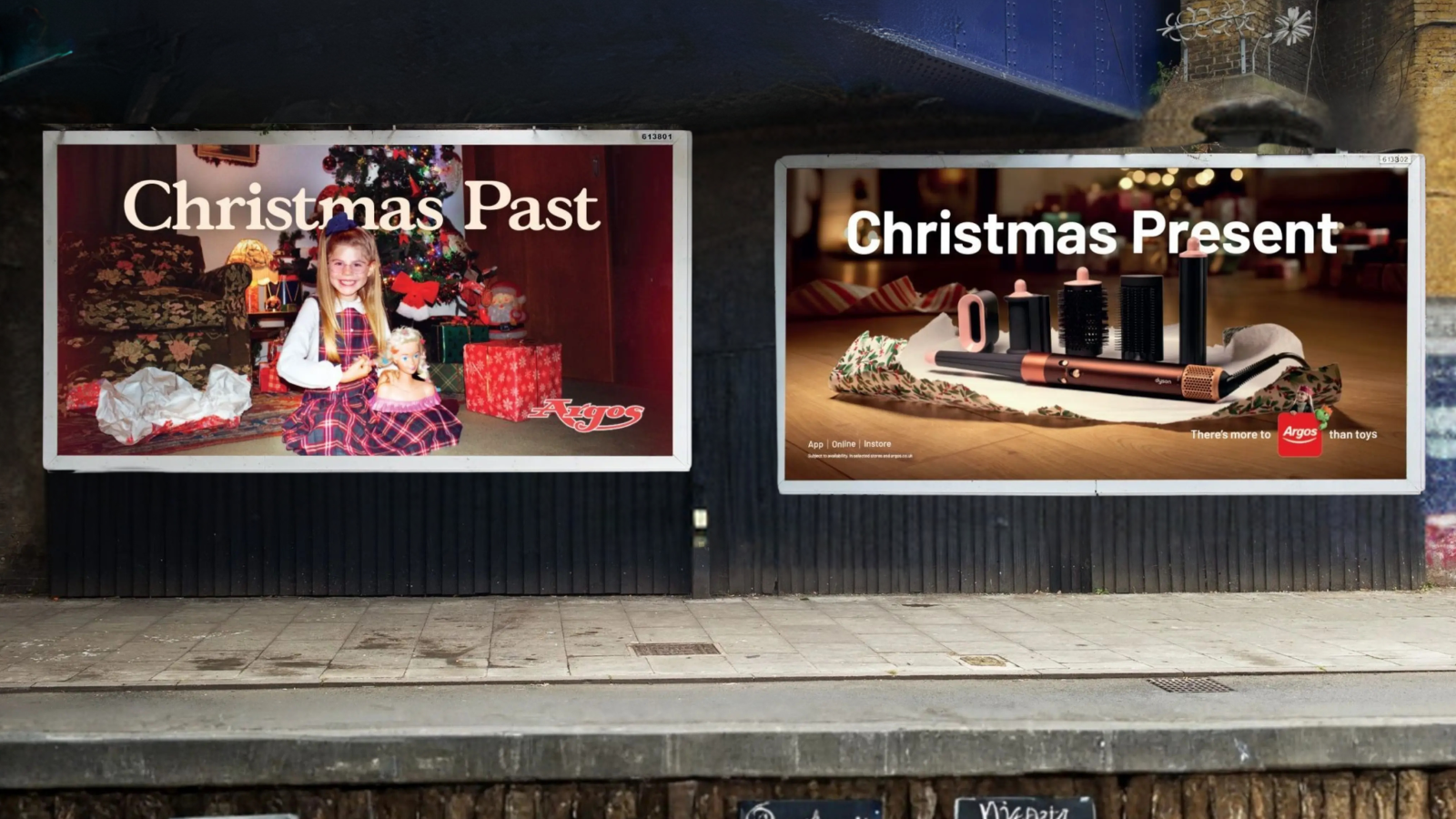
The film is the bit that got the coverage. The out-of-home is the bit I'd study. It pairs items from the old catalogue with their modern equivalents: an original Mr Frosty alongside a Ninja Slushi, a Game Boy Colour alongside a Nintendo Switch 2.
The brief was a perception problem at the worst time of year
My reading is that the real brief went something like this: in the one season when we sell the most toys, get people to think of us for everything else. That's an awkward ask. Christmas is when the toy-shop perception is most true, and when it is most commercially useful.
So the campaign had to widen how people see Argos without walking away from the thing that brings them through the door in November. Any answer that ignored toys would feel odd. Any answer built on toys would make the problem worse.
The obvious answers would have made the problem worse
The first obvious answer is a range ad. A montage of kitchen gadgets, headphones, a television and a games console, finished with a line about something for everyone. Every large retailer says that in November, and anyone who wants everything in one place already has an app for it. Range stated as a claim is a list, and nobody remembers a list.
The second obvious answer is nostalgia as mood. The season is full of it this year. Argos has a better nostalgia asset than almost anyone, because a generation of British adults grew up turning the pages of that catalogue and circling what they wanted.
But nostalgia used for warmth alone would tell people what they already think. Argos is the place they wanted toys from when they were eight. A soft-focus trip back to the catalogue would have reinforced exactly the perception the brief was trying to shift.
The idea puts the thing you wanted at eight next to the thing you'd buy now
The pairs solve both problems at once. Look at what each one actually does.
The old item is the hook. Mr Frosty and the Game Boy Colour are specific, and specific memories stop people in a way that general fondness doesn't. The new item is the sale. A Ninja Slushi is a kitchen appliance for adults, and the jump from a children's toy to that is the range argument made without a word of copy.
The pairing also lands on the right person. The person who once circled a Mr Frosty in the catalogue is now the adult holding the bank card, buying for themselves or for children of their own.
The memory sells the new product instead of the old brand.
That is the move I think most nostalgia work this season misses. Looking back is easy to do and pleasant to watch. Making the look back carry a current product, at a current price, to the person who will buy it, is harder and much more useful.
The Scrooge film is the familiar part, and it earns its place
A Christmas Carol has been borrowed by festive advertising more often than anyone could count. As a structure it has been done, and Argos didn't pretend otherwise. What makes it fit here is that the Ghost of Christmas Past maps neatly onto a brand whose biggest asset is its own past.
Casting Ayoade as the man who can't let go of the catalogue is the smart touch. It lets Argos tease the people who are fond of the old Argos, and arguably tease itself, before making the turn the brief needed: the past was lovely, now look at what's here.
Still, if I were briefing the next round, I'd make the pairs the hero. The film explains the idea. The posters are the idea.
Where I'd take the pairs next
The obvious extension is more posters with more pairs. I'd make it personal instead. Call it Your Catalogue Year: you enter the year you turned eight, and you see the item you'd most likely have circled that Christmas, set next to the product Argos sells now that answers the same want.
It works socially because everyone's year is different, and people will happily argue about which year had the best catalogue. It works commercially because every result ends on something in stock today. Whether the archive exists in a form that makes this possible is a question for Argos's own team, but the shape of the idea holds either way.
There's a version that runs forward as well. Parents could see what their own child is likely to circle this year, framed as the thing they'll still be talking about at forty. That turns the nostalgia from something you look back on into something you're buying now.
What to borrow for your own brief
When a brief says "change how people see us", the reflex is to argue with the perception. That rarely works, because you're asking people to give up a memory in exchange for a claim.
The Argos approach is to find where the perception actually lives, which is usually a specific memory, and stand the new thing next to it. Two questions get you there:
- What do people already remember about us, in detail?
- What is the current version of that memory, the thing we sell now that answers the same want?
If you can put a then and a now side by side and the jump between them says something, you have an idea. If you can't find a now worth pairing with the then, the problem isn't the advertising. It's the brief, and that's where to start.